REAL organizations, REAL SHIFTS
flow looks like this
Real founders. Real metrics. Real shifts from hustle to flow.
Each case study below is a wellness business that ran the methodology and came out the other side with a working system. The metrics are theirs. The shifts are real. The pattern is the same: strategy first, then build, then measurement.
A NOTE ON WHAT'S HERE
Every case study answers the same four questions.
What was happening in the business going in. What we built together. What changed after the build. What the owner says about it now. The structure is consistent on purpose, so you can compare apples to apples and see yourself in a similar light.
YOGA AND FITNESS STUDIO WITH TWO LOCATIONS

The situation going in
Chrissy and her husband Chris had built something real in Allentown, NJ: a yoga and movement studio with a community that kept showing up. When they opened a second location in Bordentown in January, the doors opened before the rest of the business caught up. The website still spoke as if there was only one studio. Bordentown's slightly different vibe had no place to live. And the systems that ran one location were now stretched thin across two.
The deeper problem was where their hours were going. Between them, Chrissy and Chris were losing over eight hours a week to phone calls about questions a website should answer: schedule, pricing, what to wear, how to start. Those calls turned into long conversations because that's the kind of people they are. Chrissy is the face and embodiment of The Movement. She teaches, trains teachers, leads retreats, holds the brand. Her time on the phone answering "which class should I take" was the most expensive time in the business.
The Shift
We started further back than the phone. The calls weren't the problem; they were the symptom of a brand that hadn't caught up to a two-studio reality, and a website that couldn't do its job.
So the strategy came first. A messaging platform and brand book gave The Movement one voice that holds both studios as one family while letting each location's distinct personality breathe. Hallmark selection carried the brand from the physical spaces into the digital presence, so what you feel walking into either studio is what you see on the screen. Everything downstream came from that book: the website copy, the design, the way both locations show up in local search. Built alongside Chrissy, in her voice, which is why people keep telling her it sounds and looks like her.
What changed is visible where it counts. The questions that used to become long phone conversations get answered on the site before anyone picks up the phone, and call and DM volume has come down as the website took over the explaining. Trials that used to require a conversation now start on their own. Bordentown has a home. And at least once a week, someone stops Chrissy, unprompted, to talk about the website.
The engagement also built a fuller automation layer: a trained chatbot, a unified inbox, a trial-to-membership nurture sequence, automated review responses. Chrissy and Chris ran it, saw what it could make possible, and chose to keep every conversation personal and manual for now. The website and its forms bring inquiries straight to their inbox, and they answer in their own voice. That's the deal when a system is built to land in your hands: you decide what runs. Alongside, not for.
What we built
A brand strategy engagement establishing an umbrella brand across both locations, with room for each studio's distinct personality
A brand book with a full messaging platform, the source that drove the website copy and design
Hallmark selection unifying the physical studios with the digital presence
A new website representing both Allentown and Bordentown with a "two studios, one family" architecture
Google Business Profile consolidation across both locations for clean local search
FAQs and forms on key pages that answer the common questions and deliver inquiries straight to the owners' inbox
A fuller automation layer, built and run, that the owners chose to set aside in favor of the personal touch, ready for the next stage of growth
"Since she did the website, at least once a week somebody stops me: 'Oh my God, your website.' I gave her a couple of cues, the colors, the style, what I needed, and she took the vision and curated it. It's phenomenal."
chrissy frascella, the movement
YOGA AND WELLNESS STUDIO IN HOWELL, NJ
The situation going in
Tee Guilmette had spent twenty years as a massage therapist and about eight years ago transitioned into a yoga teacher building community and students across other people's studios. When she opened her own space in Howell in February 2026 as MamaTee Wellness, the studio was new but almost nothing in her marketing reflected it. Her website was thin and still pointed to a version of her business that existed before the doors opened. There was no Google Business Profile, no business email, no consistent branding, and no way for past students to find their way back to her except through whatever she posted on socials.
Everything depended on her showing up on Instagram. New student growth was a slow trickle. Former students who would have gladly followed her had no way to know where she'd landed.
The studio was ready. The system pointing people to it was not.
What we built
- A new website that actually shows the studio she opened, with messaging and brand hallmarks built around the small-room practice she teaches
- Google Business Profile setup and verified so she shows up in local search and maps. (Ask Maps is a new AI feature in Google Maps that makes a complete profile even more important.)
- A2P verification and a business phone number so texting could be a real channel, not a personal cell
- Missed call text-back automation that opens a conversation the moment she can't get to the phone (which is most of the time, because she's teaching or working in the community)
- Review request automation that turns satisfied students into a steady stream of Google reviews
- Form submission notification automation so questions from the website about classes, private sessions, and tonic orders never sit unread
- Email template design and a personalized communication to convert contacts into sms subscribers
- A single platform to manage every channel of communication in one place
The Shift
Students are finding her on Google now, not just through the algorithm. Missed calls are starting conversations instead of going nowhere. Forms are bringing in inquiries about classes and, unexpectedly, former students reaching out about private sessions. Reviews started at zero, now sit at 14, and climb weekly. The studio has the local digital footprint it could have had on day one.
The shift she names herself is quieter and harder to measure on a dashboard: her family has started to notice. The growth is visible to the people closest to her, which tells you something about the difference between a business that depends on you posting and a business that runs while you teach.
Shift hustle to Flow truly lives up to its name Because that is exactly what working with Melissa Hindle has done for my business. Shifted my hustle so that my business could FLOW!! Melissa‘s focus and commitment to her clients is unmatched. Her highly driven work ethic and meticulous attention to detail created a beautifully elevated feel to my business page that was not present before, which far exceeded my expectations. Everything about what she helped me build for my website is ME! it feels as authentic as my fingerprint and I could not be happier with the result. She goes above and beyond making herself available if I have any questions or hiccups. She consults with me regularly to assure that things are moving flowing in alignment with our plan that we configured in our initial consultation. I’m excited and look forward to watching what we’ve created grow! The overall experience was well planned and seamless. Thanks to her dedication skill and expertise. I couldn’t be more grateful!
Tee Guilmette, MamaTee Wellness
Small-Batch, Handmade Soapmaker in Middlesex County, NJ

The situation going in
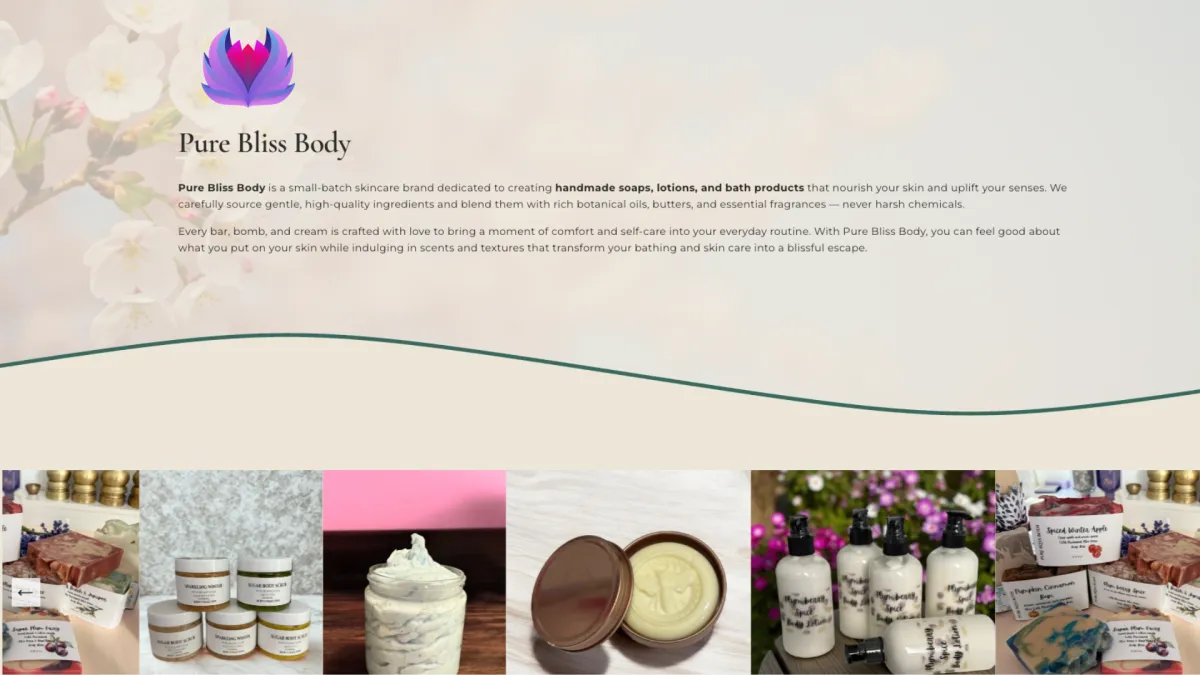
Pure Bliss Body is smaller than most businesses I work with, but the diagnosis was one I see at every size: before a website can sell anything, it has to be trusted. This is what starting further back looks like when the real problem is credibility.
Pat runs Pure Bliss Body, a handmade bath and body brand based in Middlesex County, NJ. Cold-processed soaps, body washes, lotions, scrubs, bath bombs, gift sets, all made by hand in small batches. She sells beautifully in person at local markets and events. The website was a different story. With a major spring market season weeks away and a real opportunity to convert event customers into year-round online buyers, the site had produced one or two small sales total.
The site itself was leaking trust at every layer: phone numbers that did not match across channels, an email that did not match the domain, broken social links, no Google Business Profile, missing product descriptions, a homepage carousel that was not clickable. There was also no way to capture a customer's contact information at an event, which meant every booth shutdown was the end of the relationship.
What we built
A brand voice and messaging foundation, plus a brand book Pat can carry across product labels, signage, and digital
A logomark with new color palette, formal logo, email template, brand hallmarks, a signup card to throw in the bag at markets
A website refresh focused on customer-forward messaging, trust signals, clickable product carousel, and add-to-cart access from the homepage
Consistent contact information across phone, email, and social so every channel says the same thing
A text opt-in capture system with a memorable shortcode (Text BLISS to a dedicated number) for use at events and on the website
An event opt-in workflow so contacts captured at the booth flow into a nurture sequence the same day
A first-sale nurture sequence for new opt-ins
A repeat-customer nurture sequence so the path back to a second purchase is no longer broken
A product sample size introduced for sale online and at events as a low-friction first purchase
A measurement framework so monthly performance can be tracked against goal, not guessed at
The Shift
The credibility gaps closed first: every channel now says the same thing, every link works, and the brand looks like the product deserves. Then the first signal showed up before the refreshed site was even fully live. An organic sale came through almost immediately after we published. A repeat sale followed shortly after, which says less about the website and more about Pat's product, but tells you something important: the path back to a second purchase is no longer broken.
The bigger test is the spring market season, where Pat will be in front of new customers nearly every weekend from late April through June. The system was built specifically for that wave, and we are measuring all of it together.
I love working with Melissa at Hindle Consulting. She was able to take my business ideas and put them into an actionable plan that has returned results for my small business. The one goal we have been working on is my online presence and she nailed it. Updated my website with a professional look, and also made it easy for me to maintain going forward. I highly recommend her skills.
pat mahoney, pure bliss body
WHAT STAYS THE SAME ACROSS CASES
The names change. The pattern doesn't.
Every case starts with an owner who's the bottleneck and ends with a system that runs in the background. The specific automation, the specific website, the specific sequence shifts business to business. The shape of the work is the same. That consistency is the methodology doing its job.
Want yours to be the next one?
Every case study above started with a clarity call to dig in. Yours can too.
Running a nonprofit? The pattern holds.
An executive director's inbox floods the same way a studio owner's does, and the system that answers it gets built the same way: diagnosis first, then the build, then the measurement. The next case study on this page could be a nonprofit's. Maybe yours.
Found money.
There may be $10,000 a month in free Google advertising your nonprofit qualifies for and isn't using. It's called the Google Ad Grant. Most executive directors have never heard of it. Some had it once, set up by a person who left, and it quietly died with their departure. If either sounds like your organization, bring it up on a clarity call. It costs nothing to find out, and I'll tell you plainly whether it's worth pursuing.
Join the list
I'll keep you updated on the latest article from my newsletter, The Strategic Clarity Brief, along with other updates, events, and promotions.
COMPANY
CONNECT
LEGAL
FOLLOW US


Copyright 2026. Shift Hustle to Flow. All Rights Reserved.